
Long before digital tools transformed the humanities, one of the most ambitious scholarly projects in the English-speaking world was quietly taking shape at the University of Michigan. Complication of The Middle English Dictionary (MED) began in 1925 and was completed in 2001. It is the most comprehensive resourse for the English language as it was used between 1100 and 1500 — a period of enormous change in the vocabulary, grammar, and culture.
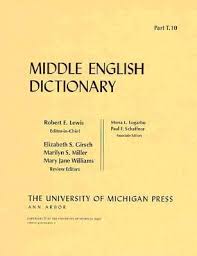
The project began under Professor Samuel Moore in the Department of English Language and Literature, who envisioned a dictionary on the scale of the Oxford English Dictionary, but focused solely on the Middle English period. His successors carried it forward across generations, with major leadership from Hans Kurath and Sherman Kuhn. What followed was a scholarly feat that stretched over 76 years.
The method was as massive as it was meticulous. Hundreds of readers—faculty, graduate students, and staff—read through medieval texts of all kinds: sermons, poems, medical manuals, cookbooks, legal documents. As they read, they copied every notable word and its surrounding context onto individual slips of paper. These “quotation slips,” more than a million in total, were then sorted by word and meaning. From these, lexicographers wrote detailed definitions, tracking spelling variants, meanings, grammatical roles, and changes over time.
The first published portion of the dictionary—a fascicle, or booklet of about 128 pages—appeared in 1952. Dozens more followed, released gradually over the decades. The final volume appeared in 2001, marking the end of a project that had spanned nearly eight decades.
The completed MED contains over 15,000 entries and remains unmatched for its depth and historical insight. Today, the entire dictionary is freely accessible online, and it continues to serve scholars around the world.
Few outside of medieval studies may know it, but the Middle English Dictionary stands as one of the University of Michigan’s most significant and enduring contributions to the humanities.
(Note: This article was created entirely by Jim Randolph conversing with ChatGPT. For a bit more on that conversation and other of Jim’s MED stories, go to: A Monument in Slips: Continued